 January 01, 2024
Attestation vs. Legalization: A Complete Guide for UAE Expats
Relocating to the United Arab Emirates often involves navigating complex administrative and legal requirements, particularly when it comes to foreign documents. One of the most common sources of confusion for expats is understanding the difference between document legalization and attestation. Although these terms are frequently used interchangeably, they refer to distinct steps within the document authentication process, each serving a specific legal purpose.
This guide explains the difference between attestation and legalization, outlines when each is required, and clarifies how certified legal translation fits into the process for UAE authorities.
Understanding Document Legalization
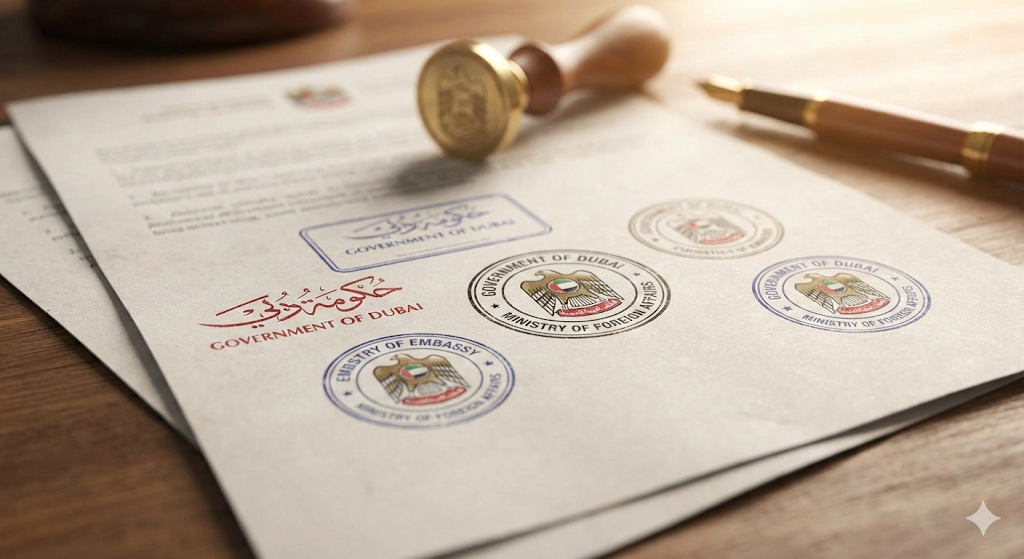
Legalization is the process of authenticating a document in its country of origin so that it can be recognized by foreign authorities. This process verifies the legitimacy of the document before it leaves the issuing country.
Legalization typically involves several steps:
• Authentication by a local notary public
• Verification by the Ministry of Foreign Affairs (or equivalent authority) in the issuing country
• Legalization by the UAE Embassy or Consulate in that country
Once legalized, the document is officially recognized by UAE diplomatic missions abroad, but it is not yet valid for use inside the UAE.
What Is Document Attestation?
Attestation refers to the final stage of document authentication after the document arrives in the UAE. This step confirms that the foreign document, already legalized abroad, is officially accepted by UAE authorities.
In most cases, attestation is completed by the UAE Ministry of Foreign Affairs (MOFA). Certain documents may also require additional attestation by specific UAE entities such as:
• Ministry of Justice
• Ministry of Education
• Relevant regulatory or licensing authorities
Without MOFA attestation, many government departments, courts, and employers in the UAE will refuse to accept foreign documents.
Key Differences Between Legalization and Attestation
Legalization:
• Occurs in the country of origin
• Involves the UAE Embassy or Consulate
• Confirms authenticity before the document enters the UAE
Attestation:
• Occurs inside the UAE
• Completed by UAE Ministry of Foreign Affairs
• Confirms official acceptance for local use
Understanding this distinction is critical to avoiding delays, rejections, and unnecessary costs.
The Role of Certified Legal Translation
Legalization and attestation authenticate the document’s origin and legitimacy, but they do not address language requirements. Most UAE authorities require documents to be submitted in Arabic.
Certified legal translation bridges this gap. After attestation, documents must be translated into Arabic by a Ministry of Justice (MOJ) certified legal translator. Courts, immigration authorities, ministries, and free zones will only accept translations produced by officially licensed translators.
Using non-certified translations or translating documents before completing attestation often leads to rejection and repeated processing.
Common Documents Requiring Legalization and Attestation
Expats in the UAE commonly need to legalize and attest documents such as:
• Birth certificates
• Marriage certificates
• Academic degrees and transcripts
• Police clearance certificates
• Powers of attorney
• Commercial and corporate documents
These documents are required for employment, residence visas, family sponsorship, business setup, and court proceedings.
Common Mistakes to Avoid
Many expats encounter delays due to avoidable errors, including:
• Confusing legalization with attestation
• Skipping UAE Embassy legalization
• Translating documents before completing attestation
• Using non-certified translators
• Submitting documents with inconsistent names or formats
Working with experienced legal translation and attestation professionals helps prevent these issues and ensures compliance with UAE regulations.
Conclusion: Proper Sequencing Ensures Acceptance
Legalization, attestation, and certified legal translation are not interchangeable steps; they are sequential requirements that must be completed in the correct order. Understanding this process allows expats to prepare documents efficiently, avoid rejection by UAE authorities, and save time and cost.
For any official use in the UAE, ensuring that documents are properly legalized, attested, and translated by MOJ-certified professionals is not optional—it is a legal necessity.